




Why do giant pandas become chubby despite eating only nutrient-poor bamboo? And is the viral brown panda Qi Zai from the Qinling Mountains a rare genetic twist or a biological anomaly? Nature is full of paradoxes like these — scientific riddles that continue to challenge conventional understanding and invite deeper exploration.
On July 4, a science exploration season opened at the Shenzhen Science & Technology Museum. Jointly organized by the Institute of Zoology of the Chinese Academy of Sciences (CAS) and the museum, the program aims to break away from the perception of science as distant and inaccessible, instead guiding the public — especially young people — into the role of “scientific detectives” solving biological mysteries.
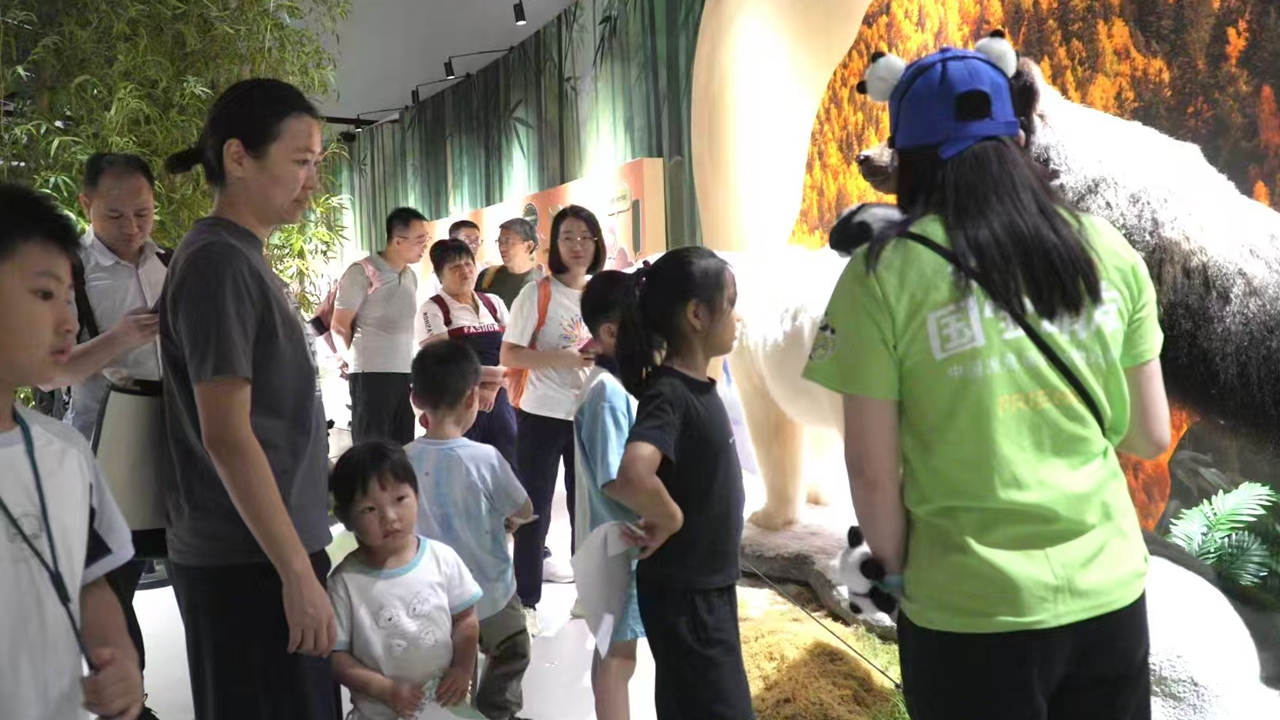
Visitors explore an exhibition highlighting China's endangered wildlife.
The initiative marks its first expansion into the Guangdong–Hong Kong–Macao Greater Bay Area, integrating cutting-edge research with public curiosity to create a summer science event that combines educational value, social relevance, and strong public engagement.
Academician Guo Chuanjie, former deputy Party secretary of CAS, told local media that in today’s AI-driven era, the exhibition transforms frontier scientific achievements into an immersive experience that is “visible, audible, perceptible, and interactive.” He emphasized that beyond knowledge dissemination, the event is designed to inspire curiosity and a spirit of inquiry among young audiences.
Zhang Jinshuo, director of the National Zoological Museum of China under the CAS Institute of Zoology, highlighted that leading scientists have been invited to give lectures and answer public questions, helping visitors better understand biodiversity and the stories behind wildlife conservation.

Zhang Jinshuo, director of the National Zoological Museum of China, speaks to reporters during an interview with local media at the Shenzhen Science & Technology Museum on July 4.
Science meets the public
The opening ceremony brought together leading scientists and science communicators from across China, including Guo Chuanjie, Zhou Dejin (former head of CAS science communication), Huang Hongyu of the CAS Guangzhou Branch, and Wang Hongmei, deputy director of the Institute of Zoology.
Speakers emphasized China’s commitment not only to major scientific and technological achievements but also to making science accessible to the public and inspiring future generations.
A highlight of the program was a keynote lecture by researcher Wang Xianhui, who translated complex zoological research into engaging, story-driven explanations. He explored topics such as the genetic mechanisms behind pandas’ unusual diet and weight gain, the survival strategies of crested ibis populations, and the ecological importance of lesser-known species.
In a roundtable discussion titled “China’s Scientific Power Behind National Treasures,” experts exchanged views on biodiversity conservation strategies and how storytelling and cultural IP can make wildlife protection more engaging both domestically and internationally.
Coordinated programming between museums
The “Discovering National Treasures: China’s Endangered Wildlife Exhibition” at the Shenzhen Science & Technology Museum is open to the public until Nov. 1, 2026. Supported by the CAS Institute of Zoology, the exhibition features more than 200 specimens of rare protected species including giant pandas, golden snub-nosed monkeys, and red pandas.
Organizers say the program not only decodes fascinating natural mysteries in an accessible way, but also creates immersive experiences that help young audiences develop a deeper appreciation for life sciences and biodiversity. Through coordinated programming between museums in northern and southern China, the initiative aims to connect world-class scientific resources with the public on a broader scale, making cutting-edge science more approachable for households across the country.