





Colorful flags billow along a main road in Shenzhen, decorated for the APEC meetings.
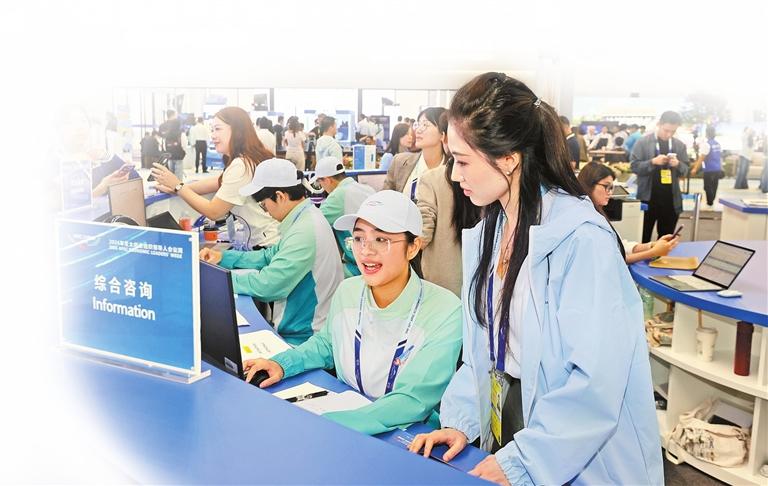
University student volunteers work at the APEC media center.
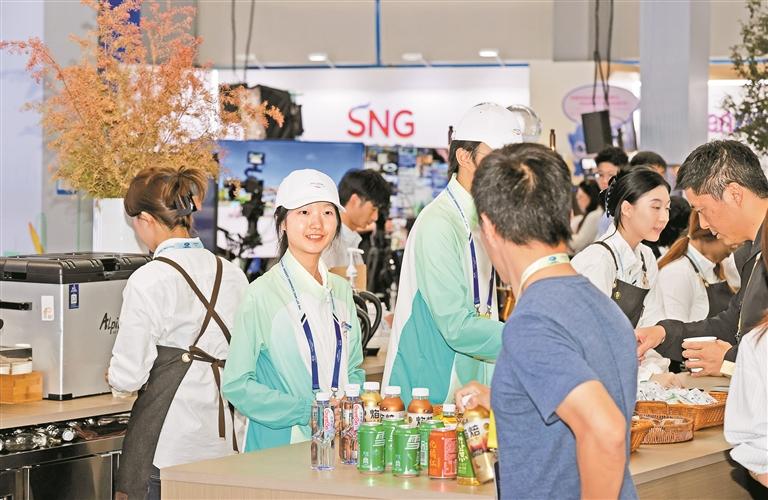
University student volunteers work at the APEC media center.
The APEC CEO Summit 2026 opens in Shenzhen on November 17. More than 1,300 university students from across Shenzhen are helping welcome delegates and keep the meetings running smoothly.
The city has also deployed more than 35,000 volunteers at venues, hotels, the airport, ports and other service points, while about 8,000 are assisting with traffic management. Municipal and district youth volunteer teams have been formed to strengthen service quality and support international visitors.
The university program drew more than 12,000 applications. Candidates underwent eligibility checks, written and oral tests, language assessments, psychological evaluations and background checks. Organizers assessed their communication skills and suitability for different roles.
“The selection included document screening, written tests, interviews and psychological evaluations to assess overall quality and service readiness,” said Zhao Zhihao, a sophomore at The Chinese University of Hong Kong, Shenzhen. He said he was excited and honored to be chosen for an event of such significance.
Conference volunteers needed English proficiency equivalent to at least China’s College English Test Band 6. Assessments also covered Korean, Spanish, Russian, French, Japanese, Vietnamese, Malay and Thai.
Tao Qin, an English major at Shenzhen Technology University, applied through her university’s official WeChat account. After résumé screening, she took an English interview on her speaking skills, volunteer experience, judgment in situations involving foreign guests, and knowledge of APEC and Shenzhen. Successful candidates then received training and took a final written assessment.
“I was overjoyed when I received the acceptance notice, and fully aware of the responsibility on my shoulders,” Tao said.
Training ran from April to November and covered general skills, specialist topics and role-specific duties. More than 2,000 hours of instruction were delivered across 13 general courses, including volunteer responsibilities, basic medical knowledge, emergency response and Shenzhen’s development. Other sessions covered first aid, language skills, international etiquette and how to introduce the city to overseas visitors.
All conference volunteers had to earn basic first-aid certification before taking up their posts. Zhao said the training was challenging because it was his first systematic introduction to emergency care.
“I learned CPR [cardiopulmonary resuscitation] and how to use an automated external defibrillator, and earned my certificate,” he said.
Tao said automated external defibrillator (AED) practice drills underscored how every moment counts in an emergency and why each step must be followed carefully.
Language training included intensive workshops, glossaries of workplace expressions and service scenarios, and university courses in cross-cultural communication and international etiquette. Role-play exercises gave students practice using foreign languages.
Asked what mattered besides language skills, Zhao and Tao both emphasized staying calm under pressure and knowing the city.
“Things can shift quickly at a large conference,” Zhao said. “We need to stay flexible and composed when something unexpected happens. Familiarity with Shenzhen and respect for different cultural traditions also help us provide professional, appropriate and warm service.”
Tao said delegates may have requests that fall outside prepared scripts, so volunteers must make sound decisions and coordinate with others. Visitors also ask about Shenzhen’s development, landmarks, transportation and local culture. Knowing the city, she said, helps volunteers share its story with people from around the world.
Before taking up her post, Tao watched practice scenarios and heard instructors review procedures for real emergencies. She said the preparation taught her to stay calm, seek guidance promptly and avoid sharing unverified information when unexpected situations arise.