




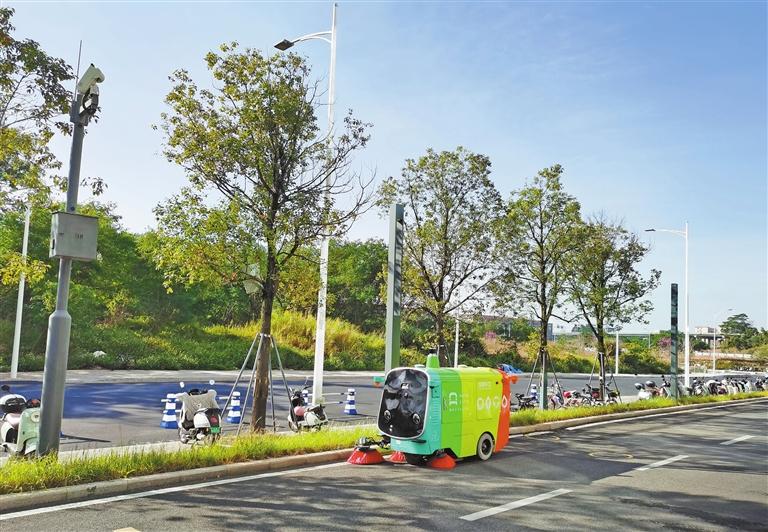
A sanitation vehicle cleans a road in Pingshan District.
Artificial intelligence (AI) sanitation robots deployed in Shijing, Kengzi, and Longtian subdistricts have won first prize at the prestigious 2025 Shenzhen International Artificial Intelligence Sanitation Robot Competition and Application Innovation Competition, highlighting Pingshan District’s strength in AI applications and urban management innovation. Across Pingshan, sanitation robots meticulously sort and collect waste while drones patrol the area to monitor conditions, offering smart and efficient services. Since 2023, Pingshan has taken the lead citywide in rolling out comprehensive, round-the-clock, all-scenario AI sanitation solutions. By integrating AI cameras, patrol vehicles, drones, and other devices, the district has built an integrated system that significantly improves sanitation efficiency. In the second half of 2025, Pingshan established AI-powered sanitation command centers in all six subdistricts, supported by 56 smart supply stations, more than 180 intelligent devices, and 300 AI cameras. A fully integrated smart sanitation system is now being rolled out to provide residents with more convenient, technology-enabled services. Beyond hardware, Pingshan has developed a smart management and decision-making platform that optimizes operations. AI algorithms dynamically plan routes based on real-time conditions, boosting work efficiency and reducing repetitive, high-intensity tasks for sanitation workers. During extreme weather, smart devices take over patrol and risk-mitigation duties, eliminating the need for staff to perform high-risk, early-morning inspections and cutting workers’ hours in harsh conditions by two hours. Human-machine collaboration has raised per-person productivity by 35%. Pingshan also operates an AI-based prediction system that analyzes historical data to forecast peak waste periods, enabling proactive deployment of smart equipment and halving problem-response times. As a result, sanitation workers’ workloads have been reduced while the urban environment has become more appealing.