



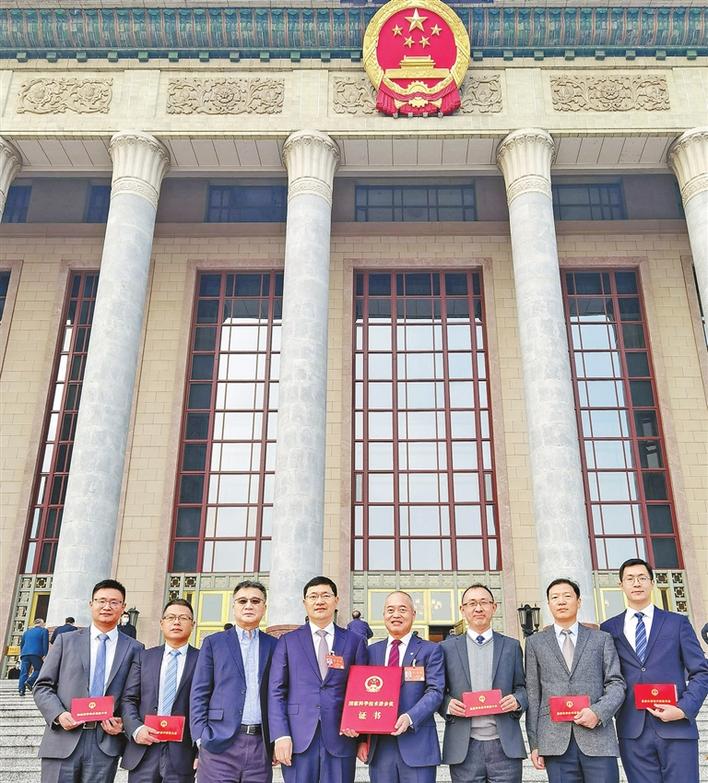
The research team led by Zheng Hairong (4th L) from Shenzhen Institute of Advanced Technology poses for a photo after winning the first prize of the State Scientific and Technological Progress Award in Beijing yesterday. Nanfang Plus
Thirteen Shenzhen projects were listed among China’s top science awardees for 2020 in Beijing yesterday, including three first-prize winners and 10 second-prize winners.
Among the total, eight won the State Scientific and Technological Progress Award, and five the State Technological Invention Award. The winning projects cover fields of electronic information, advanced manufacturing, new energy, new materials, biomedicine, resources environment, and high-tech service.
Local enterprises contributed 12 to the 13 prize-winning projects. Huawei Technologies, which played a role in three of them, has won the national science award for 14 straight years.
A research project on key technologies of high-definition video coding and decoding based on polymorphic primitives by Beijing University Shenzhen Graduate School and Huawei won the first prize of the State Technological Invention Award.
The project is expected to bring great changes to industries of smart medical treatment, smart traffic, space probe and precision equipment manufacturing.
A project of research and industrialization of high-field magnetic resonance medical imaging system by Shenzhen Institute of Advanced Technology (SIAT) of the Chinese Academy of Sciences and Shanghai United Imaging won the first prize of the State Scientific and Technological Progress Award.
A research on modern space structure system innovation and key technologies and engineering application participated by CCDI, a Shenzhen-based architectural design industry leader, won the same prize.
The high-field magnetic resonance medical imaging system is a milestone for home-grown high-end medical equipment which broke monopoly of Western countries and made China one of the few countries in the world to have independently grasped magnetic resonance technologies, following the U.S. and Germany.
The technologies and equipment have been used in over 1,000 hospitals in China, and exported to overseas markets including the U.S. and Europe, according to a release of SIAT yesterday.
A total of 148 projects from Shenzhen have won national top science awards since 2010.